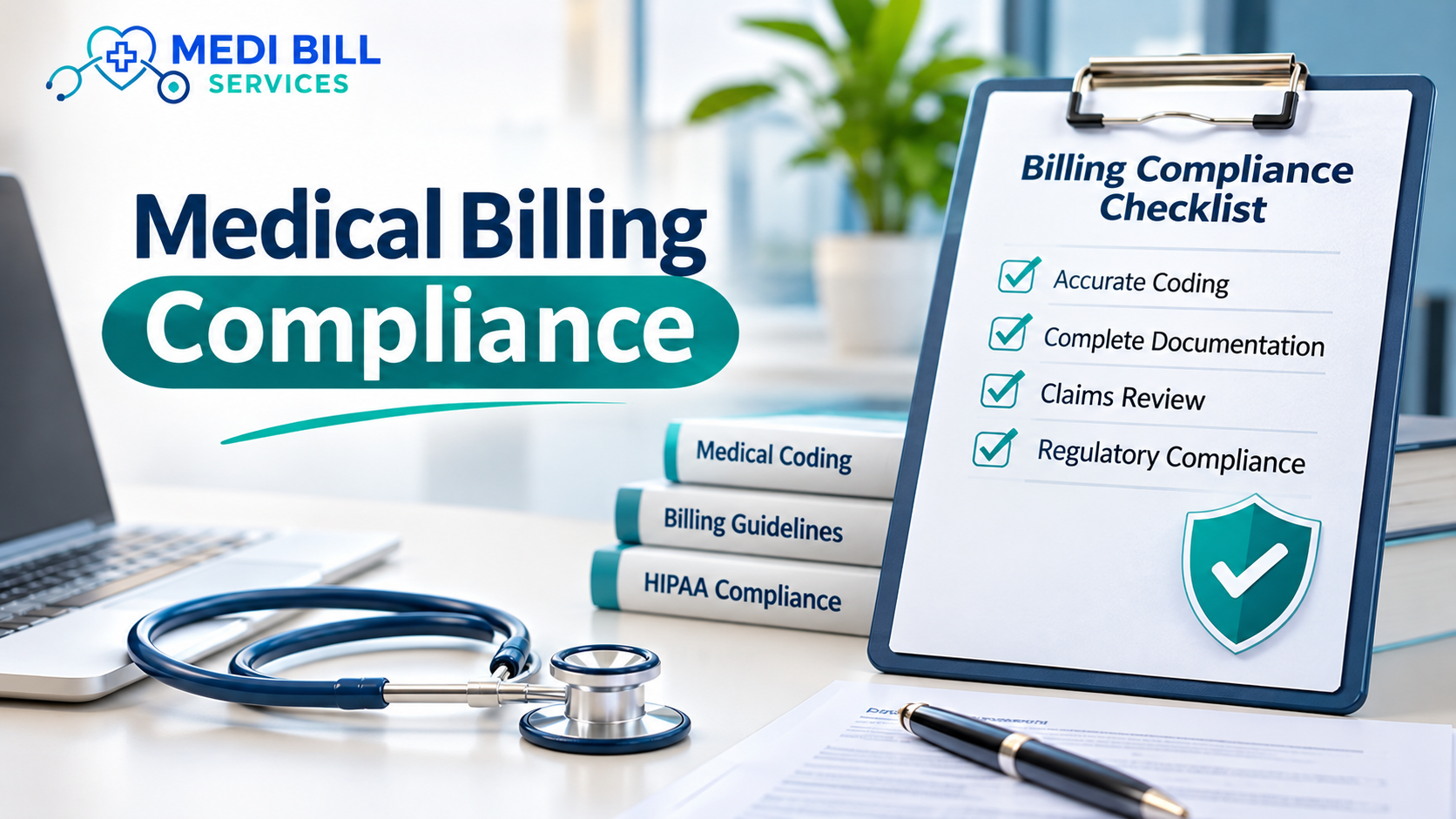
Medical Billing Compliance
Medical billing compliance is an important part of running a healthcare practice. Accurate billing requires more than submitting claims and collecting payments. Healthcare providers and billing teams also need to follow applicable coding guidelines, payer requirements, documentation standards, privacy rules, and internal billing procedures.
Billing mistakes can create claim delays, denials, payment problems, and additional administrative work. More serious compliance issues may also create regulatory or financial risks.
A structured compliance process helps healthcare practices maintain accurate records, submit claims appropriately, and identify potential billing problems before they become larger issues.
What Is Medical Billing Compliance?
Medical billing compliance refers to following applicable laws, regulations, coding standards, payer requirements, and organizational procedures when documenting, coding, submitting, and managing healthcare claims.
A compliant billing process should ensure that claims accurately represent the services provided and are supported by appropriate documentation.
Compliance can involve several areas, including:
- Accurate medical coding
- Complete clinical documentation
- Correct claim submission
- Appropriate use of modifiers
- Proper payment posting
- Insurance verification
- Patient information protection
- Denial and appeal procedures
- Staff training
- Internal billing audits
The specific requirements can vary depending on the healthcare provider, specialty, location, payer, and services being billed.
Why Is Medical Billing Compliance Important?
Medical billing compliance helps healthcare practices maintain organized and accurate billing operations.
Reduces Billing Errors
A compliance-focused workflow encourages staff to review claims and documentation before submission.
Identifying errors early can help reduce avoidable claim corrections, rework, and payment delays.
Supports Accurate Claims
Healthcare claims should accurately represent the services documented in the medical record.
Appropriate coding and documentation help ensure that submitted information is consistent with the care provided.
Helps Manage Denial Risk
Some claim denials result from coding, documentation, eligibility, authorization, or other billing problems.
Regular compliance reviews can help identify recurring issues and improve internal processes.
Protects Patient Information
Medical billing involves sensitive patient and financial information.
Appropriate access controls, secure systems, employee training, and privacy procedures help healthcare practices protect this information.
Improves Staff Accountability
Clear billing procedures help employees understand their responsibilities.
When workflows are documented and regularly reviewed, practices can identify where additional training or process improvements may be required.
Common Medical Billing Compliance Risks
Healthcare practices can face several types of billing compliance challenges.
Incorrect Coding
Incorrect diagnosis or procedure codes can cause claims to be processed incorrectly.
Coding should be based on the provider’s documentation and applicable coding guidance.
Unsupported Services
Claims should accurately reflect services that were actually provided and documented.
Billing for services without appropriate supporting documentation can create significant compliance concerns.
Incorrect Modifier Use
Modifiers provide additional information about certain services and circumstances.
They should only be used when supported by documentation and applicable coding rules.
Upcoding
Upcoding occurs when a higher-level service or code is reported than what is supported by the documentation.
Practices should ensure that code selection accurately reflects the services documented.
Unbundling
Some related services may need to be reported together according to applicable coding and payer rules.
Separately reporting services that should be bundled can create billing and compliance concerns.
Duplicate Billing
Submitting the same service or claim more than once can result in duplicate billing issues.
Billing systems and internal review procedures should help identify potential duplicates.
Incomplete Documentation
Insufficient documentation can make it difficult to support the codes and services reported on a claim.
Healthcare providers should maintain clear and complete records appropriate to the services provided.
Medical Billing Compliance Best Practices
A strong compliance process should be practical, documented, and regularly reviewed.
Maintain Accurate Clinical Documentation
Coding and billing depend on the information contained in the medical record.
Documentation should accurately describe relevant diagnoses, procedures, services, and other required information.
Coders and billing staff should not add unsupported information simply to justify a claim.
Use Current Coding Guidelines
Medical coding systems and guidelines can change.
Healthcare practices should use current coding resources and ensure that staff are aware of updates relevant to their work.
Conduct Regular Billing Audits
Internal audits can help identify patterns that may require correction.
An audit may review:
- Diagnosis coding
- Procedure coding
- Modifier usage
- Documentation
- Claim accuracy
- Payment posting
- Denial patterns
The purpose of an audit should be to identify problems, understand their causes, and implement appropriate corrective action.
Train Billing and Coding Staff
Regular training is important because billing requirements and coding guidance can change.
Training should focus on the areas most relevant to the practice’s specialty and common billing issues.
Establish Written Billing Procedures
Written procedures help staff follow consistent processes.
Document procedures for claim submission, corrections, denials, appeals, payment posting, patient billing, and escalation of unusual situations.
Monitor Denial Patterns
Denials can provide useful information about weaknesses in billing workflows.
For example, repeated coding-related denials may indicate a need for additional coding review or staff training.
Protect Patient Information
Billing teams should have access only to information necessary for their responsibilities.
Healthcare practices should use appropriate security controls, employee training, secure systems, and privacy procedures based on applicable requirements.
How Internal Billing Audits Work
A billing audit is a structured review of billing records and related documentation.
Select a Review Period
The practice chooses a defined period or group of claims for review.
The scope may depend on the practice’s size, specialty, billing volume, and identified risks.
Review Medical Records
Auditors compare billed services with the relevant clinical documentation.
The goal is to determine whether the reported information is supported by the records.
Review Coding
Diagnosis and procedure codes are compared against the documentation and applicable coding guidance.
Any discrepancies should be documented for further review.
Review Claims
The submitted claim is checked for patient information, provider information, service dates, codes, modifiers, and other relevant details.
Document Findings
Potential errors or process weaknesses should be recorded clearly.
The practice can then determine whether corrective action, additional training, or workflow changes are needed.
Monitor Improvements
After changes are implemented, practices should review whether the identified problem continues to occur.
Ongoing monitoring helps determine whether corrective actions are effective.
Medical Billing Compliance and HIPAA
Healthcare billing involves patient information, which means privacy and security considerations are important.
For organizations subject to HIPAA, billing operations must follow applicable requirements for protecting protected health information.
Important areas may include:
- Authorized access
- Secure information handling
- Employee training
- Appropriate business associate arrangements
- Data security procedures
- Incident response processes
Practices should obtain appropriate professional or legal guidance when determining their specific regulatory obligations.
Role of Staff in Billing Compliance
Compliance is not only the responsibility of the billing manager.
Different team members can affect billing accuracy.
Front Desk Staff
Registration teams collect patient demographic and insurance information.
Accurate information at registration can help prevent downstream billing problems.
Healthcare Providers
Providers create clinical documentation that supports coding and billing.
Clear documentation is essential for accurately representing the services provided.
Medical Coders
Coders translate clinical information into standardized diagnosis and procedure codes.
Their work should follow applicable coding guidelines and payer requirements.
Billers
Billers prepare and submit claims, monitor claim status, and manage billing follow-up.
They should understand payer requirements and internal billing procedures.
Practice Managers
Managers help establish policies, review billing performance, support staff training, and monitor compliance processes.
A coordinated approach across the practice can make compliance more effective.
How Technology Can Support Billing Compliance
Technology can help healthcare practices organize billing workflows and identify certain errors.
Depending on the system, technology may support:
- Claim validation
- Coding edits
- Eligibility verification
- Duplicate claim checks
- Denial tracking
- Audit reporting
- Payment reconciliation
- Access controls
Technology should be used as a support tool. Practices still need qualified staff to review documentation, interpret coding requirements, and make appropriate decisions.
What to Look for in a Medical Billing Partner
Healthcare providers that outsource billing should evaluate potential billing partners carefully.
Important factors include:
Industry Experience
Look for experience with the relevant healthcare specialty and payer environment.
Clear Processes
The provider should be able to explain how claims, denials, corrections, and appeals are handled.
Reporting
Regular reports should provide useful information about billing activity, outstanding claims, denials, and other agreed metrics.
Security Procedures
Ask how patient information is protected and how access to billing systems is controlled.
Staff Training
Determine whether billing staff receive regular training and how the company handles changes in coding and payer requirements.
Clear Contract Terms
The agreement should clearly define responsibilities, services, pricing, reporting, communication, and procedures for handling problems.
How Medi Bill Services Can Support Healthcare Providers
Medi Bill Services provides medical billing-related support for healthcare providers seeking assistance with billing workflows and revenue cycle activities.
Depending on the services selected, healthcare practices may seek support with claim processing, denial follow-up, payment tracking, and accounts receivable management.
Practices considering outsourced billing should confirm the services, responsibilities, reporting, and compliance procedures included in their specific arrangement.
Explore the medical billing services page to learn more about available support. You can also visit the medical specialties page for information relevant to different healthcare practices.
Conclusion
Medical billing compliance is an important part of maintaining accurate and organized healthcare billing operations.
By using appropriate coding, maintaining complete documentation, conducting regular audits, training staff, protecting patient information, and monitoring billing patterns, healthcare practices can identify potential problems and improve their workflows.
Compliance should be treated as an ongoing process rather than a one-time task. Regular reviews and staff education can help practices respond to changing requirements and maintain more reliable billing procedures.
A well-structured billing process can support accurate claims, better administrative organization, and more effective revenue cycle management.
Frequently Asked Questions (FAQs)
What is medical billing compliance?
Medical billing compliance means following applicable laws, regulations, coding guidelines, payer requirements, documentation standards, and internal procedures when managing healthcare billing and claims.
Why is medical billing compliance important?
It helps healthcare practices submit accurate claims, maintain proper documentation, protect patient information, reduce avoidable billing errors, and identify potential compliance risks.
How can a medical practice improve billing compliance?
Practices can improve compliance by using current coding guidelines, conducting regular audits, training staff, maintaining accurate documentation, monitoring denial patterns, and establishing clear billing procedures.
What is a medical billing audit?
A medical billing audit is a structured review of claims, coding, documentation, and billing processes to identify errors, inconsistencies, or areas that may require corrective action.
Can outsourcing medical billing help with compliance?
An experienced billing company may provide structured billing processes, trained staff, reporting, and audit support. However, healthcare providers should carefully evaluate the company’s processes and clearly define compliance responsibilities in the service agreement.