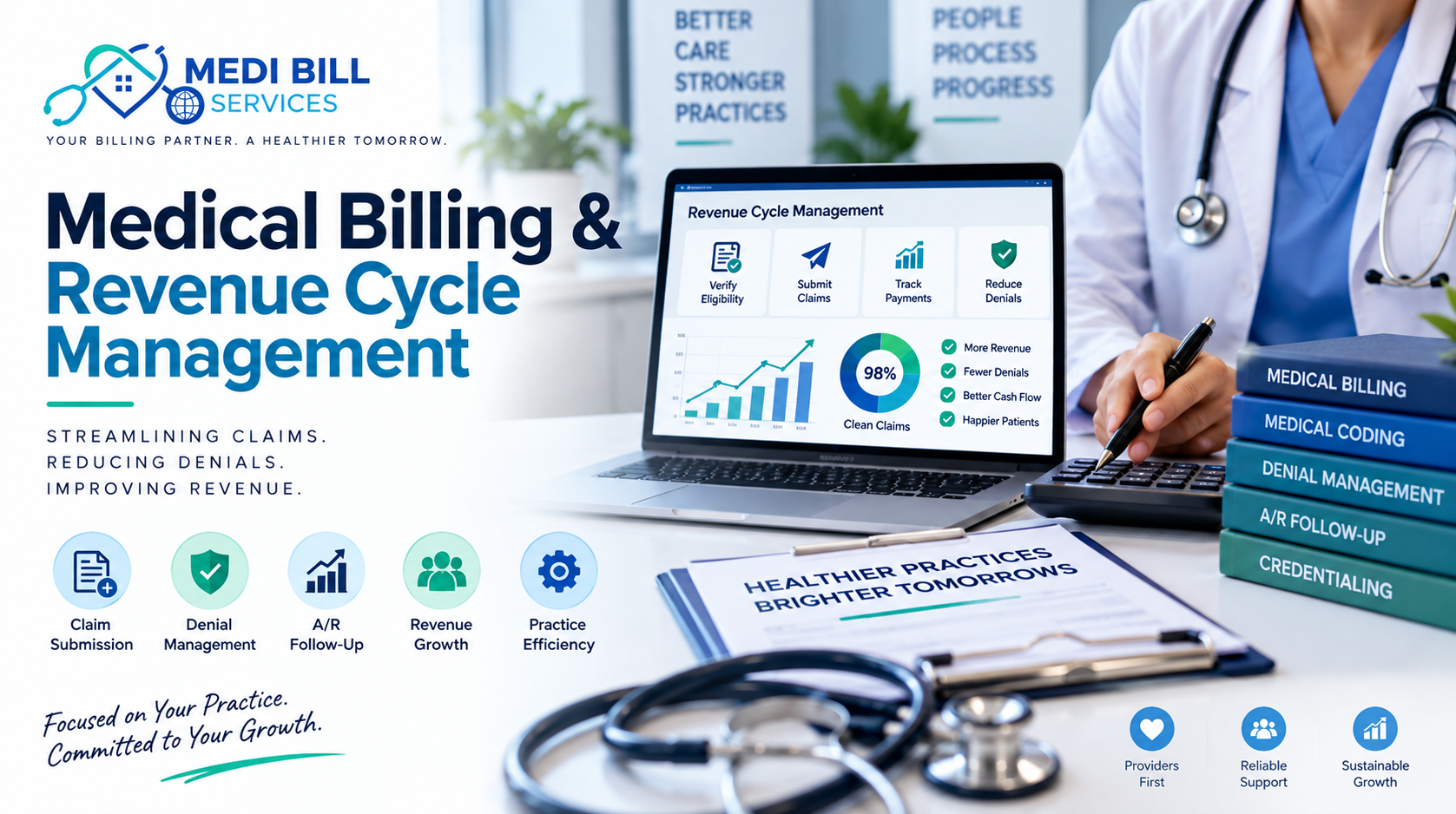
Medical Billing & Revenue Cycle Management
Healthcare practices need more than quality patient care to operate successfully. They also need an efficient financial process that ensures claims are submitted correctly, payments are collected, and outstanding accounts are followed up consistently.
This is where medical billing and revenue cycle management (RCM) become essential.
A well-managed revenue cycle can help healthcare providers organize their billing operations, reduce avoidable claim issues, manage denials, and improve the overall efficiency of their practice.
In this guide, we’ll explain what medical billing and RCM are, how they work together, their key benefits, and what healthcare providers should consider when choosing professional billing support.
What Is Medical Billing?
Medical billing is the process of submitting healthcare claims to insurance companies and managing the payment process after a patient receives medical services.
The process generally involves collecting patient and insurance information, reviewing documentation, assigning appropriate codes, submitting claims, posting payments, and following up on unpaid or denied claims.
Professional medical billing services can help healthcare providers manage these responsibilities while reducing the amount of administrative work handled internally.
What Is Revenue Cycle Management?
Revenue Cycle Management, or RCM, is broader than medical billing.
RCM covers the entire financial journey of a healthcare service, from the initial patient registration and insurance verification through claim submission, payment collection, and accounts receivable follow-up.
A typical revenue cycle may include:
- Patient registration
- Insurance eligibility verification
- Authorization and benefit verification
- Medical documentation
- Medical coding
- Charge entry
- Claim submission
- Payment posting
- Denial management
- A/R follow-up
- Patient billing
When these steps are properly coordinated, practices can maintain a more organized and efficient financial workflow.
How Medical Billing and RCM Work Together
Medical billing is an important part of the overall revenue cycle.
For example, a provider may deliver a service to a patient, but the practice cannot receive reimbursement simply because the service was provided. The service must be documented, coded, billed, submitted to the appropriate payer, and followed through until payment is received.
If something goes wrong at any stage, the payment process may be delayed.
That’s why healthcare practices often look at billing as part of a complete revenue cycle management strategy rather than treating each billing task separately.
Key Components of Medical Billing & RCM
1. Patient Registration
Accurate patient information is the foundation of the billing process.
Information such as the patient’s name, date of birth, insurance details, and other required information should be collected correctly.
Errors at registration can create problems later when claims are submitted.
2. Insurance Eligibility Verification
Before providing services, healthcare providers need to understand whether a patient’s insurance is active and what benefits may apply.
Medi Bill Services provides Auth and Benefit Check Services to help healthcare providers verify insurance eligibility and benefits.
This can help identify potential coverage issues before they become billing problems.
Internal Link: Auth and Benefit Check Services
3. Medical Coding
Medical coding converts information from clinical documentation into standardized codes used for billing and insurance claims.
Accurate coding is important because coding errors can contribute to claim rejections, denials, and payment delays.
Professional medical coding services can help healthcare practices maintain an organized coding process.
Internal Link: Medical Coding Services
4. Charge Entry
Once services have been documented and coded, the appropriate charges need to be entered into the billing system.
Accurate charge entry helps ensure that services are properly represented on the claim.
5. Claims Submission
Claims need to contain accurate patient, provider, insurance, coding, and service information.
A professional medical billing team can review and submit claims while helping identify common errors that could interfere with processing.
Internal Link: Medical Billing Services
6. Payment Posting
After insurance companies process claims, payments and adjustments need to be recorded accurately.
Proper payment posting gives practices a clearer picture of what has been paid, what remains outstanding, and whether additional follow-up is needed.
7. Denial Management
Denied claims can delay reimbursement and increase administrative workload.
Effective denial management involves reviewing why a claim was denied, determining the appropriate next step, correcting issues when appropriate, and following up with the payer.
Medi Bill Services offers Denial Management Services to help healthcare providers address denied claims and identify recurring billing issues.
Internal Link: Denial Management Services
8. Accounts Receivable Follow-Up
Accounts receivable, commonly called A/R, represents money that is still owed to the healthcare practice.
Consistent A/R follow-up can help identify unpaid claims and outstanding balances that require attention.
Medi Bill Services provides A/R Follow-Up Services to support providers in managing outstanding accounts.
Internal Link: A/R Follow-Up Services
Benefits of Professional Medical Billing & RCM
Improved Billing Efficiency
Professional billing support can organize different stages of the revenue cycle and help ensure that claims and payments are handled consistently.
Reduced Administrative Work
Managing billing internally can consume considerable staff time. Outsourcing selected billing tasks can allow practice employees to focus on other important responsibilities.
Better Denial Management
Regular review of denied claims can help practices identify recurring problems and improve their billing processes.
Stronger A/R Management
Following up on outstanding claims can help practices maintain better control over unpaid accounts.
Better Revenue Cycle Visibility
A structured RCM process can give providers greater insight into claims, payments, denials, and outstanding balances.
Medical Billing for Different Healthcare Specialties
Medical billing requirements can vary depending on the healthcare specialty.
Different specialties may have different coding requirements, documentation practices, payer policies, and reimbursement processes.
Medi Bill Services provides specialty-focused billing support for healthcare areas such as:
- Endocrinology
- Pediatrics
- Podiatry
- Allergy & Immunology
- Geriatrics
- Acupuncture
- Laboratory & Pathology
- Orthopedics
Healthcare providers can explore the company’s specialty offerings through its Medical Specialties section.
Telehealth and Revenue Cycle Management
Telehealth has become an important part of modern healthcare delivery.
However, virtual healthcare services can involve specific billing, coding, documentation, and payer requirements.
An experienced billing team can help providers manage the financial and administrative aspects of telehealth services.
Medi Bill Services provides Telehealth Billing Services covering important parts of the billing process.
Internal Link: Telehealth Billing Services
How Denials Affect Revenue
Claim denials can have a direct effect on the healthcare revenue cycle.
When claims are denied, the practice may need to spend additional time researching the issue, correcting information, resubmitting the claim, or communicating with the payer.
Common reasons for claim problems can include:
- Incorrect patient information
- Eligibility issues
- Coding errors
- Missing documentation
- Authorization problems
- Incorrect claim information
- Payer-specific requirements
Tracking denial patterns can help healthcare practices identify recurring issues and improve their processes.
The Importance of Medical Credentialing
Medical credentialing is another important area for healthcare providers.
Credentialing involves processes related to provider enrollment and participation with insurance networks.
Medi Bill Services offers Medical Credentialing Services to support providers with the administrative requirements associated with payer enrollment and credentialing.
Internal Link: Medical Credentialing Services
How to Choose a Medical Billing Company
Choosing the right medical billing company is an important decision for any healthcare practice.
Before selecting a provider, consider the following:
Experience
Look for experience in healthcare billing and, ideally, experience with your specific specialty.
Services
Consider whether the company provides the services your practice needs, such as billing, coding, credentialing, denial management, and A/R follow-up.
Communication
Clear communication is essential. Your practice should know how billing issues and performance will be communicated.
Reporting
Regular reporting can help providers understand claims, payments, denials, and outstanding accounts.
Technology
A modern billing workflow should use appropriate technology to organize claims and revenue cycle information.
Security and Compliance
Healthcare billing involves sensitive information, so practices should carefully evaluate a billing provider’s privacy, security, and compliance practices.
Should You Outsource Medical Billing?
There is no single solution that works for every healthcare practice.
Some providers manage billing internally, while others outsource some or all of their revenue cycle operations.
Outsourcing may be worth considering when:
- Staff spend too much time on billing
- Claims are frequently denied
- A/R is increasing
- Billing follow-up is inconsistent
- The practice lacks specialized billing expertise
- Administrative workload is affecting practice operations
The right choice depends on the size of the practice, specialty, billing volume, staffing, and existing revenue cycle performance.
Final Thoughts
Medical billing and revenue cycle management are critical components of a successful healthcare practice.
From insurance verification and medical coding to claims submission, payment posting, denial management, and A/R follow-up, every stage can influence the efficiency of the revenue cycle.
Professional billing support can help healthcare providers organize these processes, reduce administrative pressure, and maintain better visibility over their financial operations.
For practices looking for professional support, Medi Bill Services offers medical billing and revenue cycle solutions designed to support healthcare providers across different specialties.
Frequently Asked Questions
1. What is medical billing?
Medical billing is the process of preparing, submitting, and managing healthcare claims so providers can receive reimbursement for services they provide.
2. What is revenue cycle management?
Revenue cycle management is the complete financial process associated with healthcare services, from patient registration and insurance verification through claims, payments, denials, and A/R follow-up.
3. What is the difference between medical billing and RCM?
Medical billing primarily focuses on claims and payment-related activities, while RCM covers the broader financial process from the beginning of the patient journey through final payment and account resolution.
4. Why is medical coding important for billing?
Accurate medical coding helps communicate diagnoses and services on healthcare claims. Incorrect coding can contribute to claim problems and reimbursement delays.
5. What is denial management?
Denial management involves reviewing denied claims, identifying the reasons for denial, taking appropriate corrective action, and following up with insurance payers.
6. What is A/R follow-up in medical billing?
A/R follow-up is the process of monitoring outstanding accounts and following up on unpaid or delayed claims to help providers collect money that remains owed.
7. Can medical billing services help reduce administrative work?
Yes. Outsourcing billing activities can reduce the amount of time internal staff spend managing claims, denials, payment posting, and other billing responsibilities.
8. Can small healthcare practices use RCM services?
Yes. Small practices can use professional RCM services when they need specialized billing support or want to reduce the administrative workload associated with revenue cycle management.
9. What causes medical claim denials?
Denials can result from several issues, including eligibility problems, coding errors, missing information, authorization issues, documentation problems, and payer-specific requirements.
10. What is insurance eligibility verification?
Insurance eligibility verification involves checking whether a patient’s insurance coverage is active and determining applicable benefits before services are provided.
11. What is medical credentialing?
Medical credentialing is the process of verifying a healthcare provider’s qualifications and completing requirements associated with insurance network participation and provider enrollment.
12. Does telehealth require special billing processes?
Telehealth services can have specific coding, documentation, and payer requirements. Providers should use billing processes appropriate to their telehealth services and applicable payer rules.
13. How can RCM improve practice cash flow?
Effective RCM can help practices manage claims efficiently, address denials, follow up on unpaid accounts, and maintain better control over outstanding revenue.
14. What should I look for in a medical billing company?
Consider experience, specialty knowledge, service offerings, communication, reporting, technology, security, and the company’s approach to denial and A/R management.
15. Is outsourcing medical billing better than handling it in-house?
It depends on the practice. Outsourcing can provide specialized expertise and reduce administrative workload, while some practices may prefer to maintain billing internally. Practices should compare their current performance, costs, staffing, and needs.