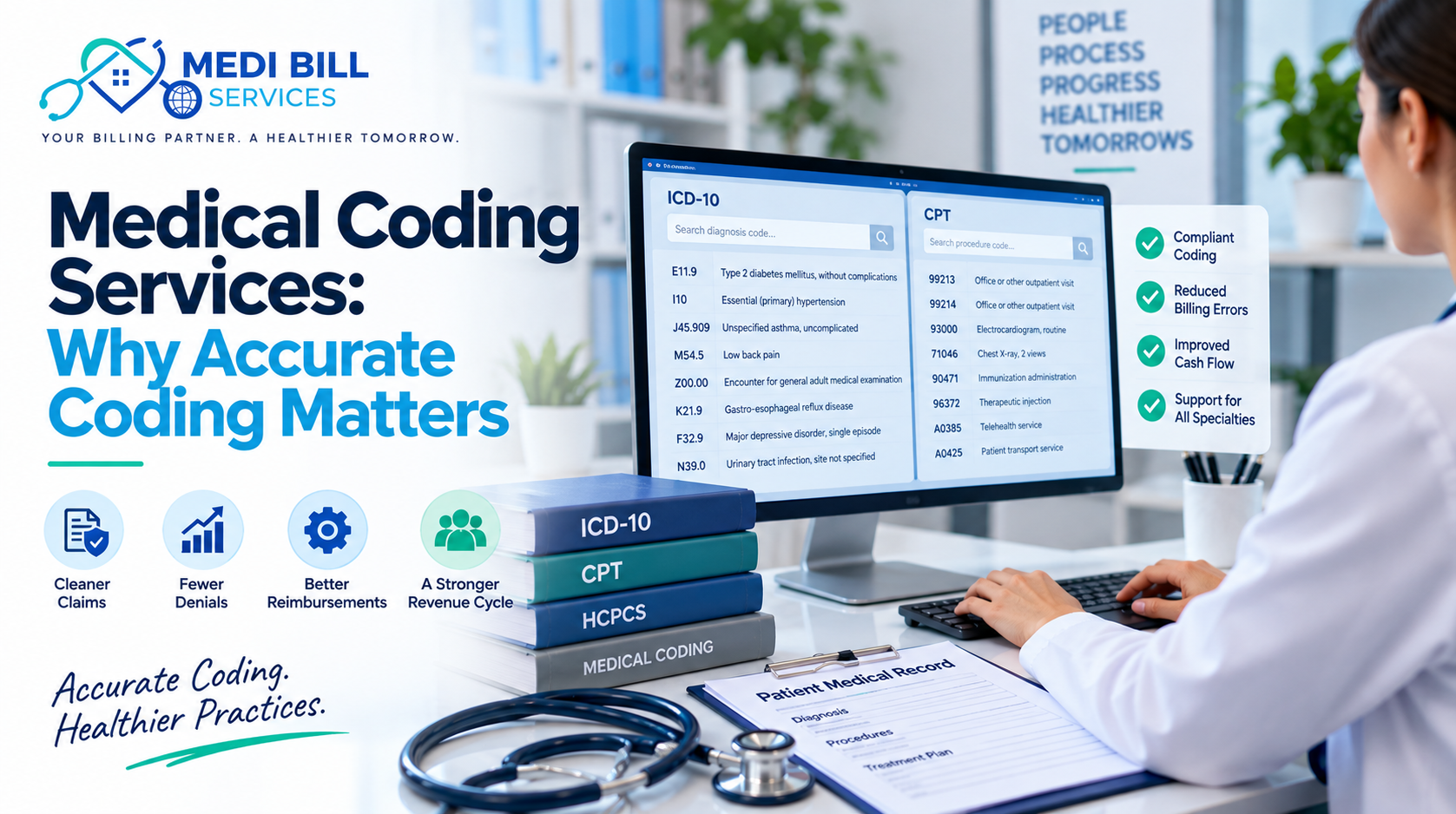
Medical Coding Services: Why Accurate Coding Matters
Accurate medical coding is an important part of the healthcare billing process. Every healthcare service provided to a patient needs to be properly documented and represented with the appropriate medical codes before a claim is submitted to an insurance payer.
When coding is incomplete or inaccurate, it can create billing problems, claim delays, or denials. For this reason, professional medical coding services can play an important role in helping healthcare practices maintain an organized revenue cycle.
In this guide, we’ll explain what medical coding is, why accuracy matters, how coding affects medical billing, and how professional coding support can benefit healthcare providers.
What Is Medical Coding?
Medical coding is the process of translating information from a patient’s medical records into standardized codes.
These codes can represent:
- Diagnoses
- Medical procedures
- Treatments
- Services provided
- Conditions affecting the patient
The coded information is then used as part of the healthcare claim submitted to an insurance company or other payer.
Because coding directly affects the claims process, accuracy is essential.
Why Is Accurate Medical Coding Important?
Medical coding is more than simply assigning numbers to healthcare services.
The codes need to accurately represent the services documented in the patient’s medical record.
Accurate coding can help healthcare practices:
- Submit cleaner claims
- Reduce avoidable billing errors
- Minimize claim delays
- Support appropriate reimbursement
- Reduce certain types of denials
- Maintain better billing records
- Improve revenue cycle efficiency
Even a small coding issue can create additional work for billing teams when a claim needs to be corrected or reviewed.
How Does Medical Coding Affect Medical Billing?
Medical coding and medical billing work closely together.
The coding process provides important information used when preparing a claim. Once the appropriate codes have been assigned, billing staff can use that information along with patient, provider, and insurance details to submit the claim.
The general process may look like this:
Patient Visit → Documentation → Medical Coding → Claim Preparation → Claim Submission → Payer Review → Payment
If the coding information is inaccurate, the problem can potentially affect later stages of the process.
That’s why professional medical coding services can be an important part of an effective revenue cycle.
Common Medical Coding Challenges
Healthcare providers and their staff can face several challenges when managing coding internally.
1. Incomplete Documentation
Coding relies on clinical documentation. If important information is missing or unclear, it may be difficult to assign the appropriate code.
2. Coding Errors
Incorrect code selection can create claim problems and may require additional review or correction.
3. Changing Requirements
Healthcare coding and payer requirements can change over time. Billing teams need to stay informed about applicable requirements.
4. High Billing Volume
Practices with a large number of patients and claims may find it challenging to maintain consistent coding accuracy while managing other administrative responsibilities.
5. Specialty-Specific Requirements
Different healthcare specialties can involve different procedures, documentation practices, and coding considerations.
How Professional Medical Coding Services Can Help
Outsourcing medical coding can provide healthcare practices with access to specialized coding support.
A professional coding team can review documentation, assign appropriate codes, and support the billing process.
This can help practices reduce the administrative burden associated with coding while maintaining a more consistent workflow.
Medi Bill Services provides Medical Coding Services as part of its healthcare revenue cycle solutions.
Medical Coding and Claim Denials
Claim denials can happen for many different reasons, and coding issues can be one potential contributor.
For example, a claim may require additional review when the information submitted does not properly support the billed service or when coding does not meet applicable payer requirements.
Strong coding processes can help reduce avoidable problems before claims are submitted.
However, when claims are already denied, an effective denial management process is also important.
Medi Bill Services provides Denial Management Services to help healthcare providers address denied claims and manage the follow-up process.
Medical Coding and Revenue Cycle Management
Medical coding is one component of the larger healthcare revenue cycle.
Revenue Cycle Management can include:
- Patient registration
- Insurance verification
- Authorization
- Clinical documentation
- Medical coding
- Claim submission
- Payment posting
- Denial management
- A/R follow-up
Every stage contributes to the overall billing process.
When coding is handled accurately and efficiently, it can help support the later stages of the revenue cycle.
For more information, healthcare providers can explore Revenue Cycle Management Services.
Benefits of Outsourcing Medical Coding
Reduce Administrative Work
Healthcare providers and internal staff can spend less time managing coding tasks and more time focusing on other practice responsibilities.
Access Specialized Expertise
Professional coding teams focus on coding-related processes and can help practices manage the complexity of healthcare billing requirements.
Improve Workflow
A dedicated coding process can create a smoother transition between documentation, coding, and claim submission.
Support Cleaner Claims
Accurate coding can help reduce certain avoidable claim issues and support a more efficient billing workflow.
Scale With Practice Growth
As patient volume increases, outsourced coding support can help practices manage additional administrative workload.
Medical Coding for Different Specialties
Coding requirements can vary between healthcare specialties.
For example, the documentation and services involved in orthopedics may differ significantly from those involved in pediatrics, podiatry, endocrinology, or laboratory services.
Medi Bill Services provides revenue cycle support across multiple healthcare specialties.
You can explore the available specialty areas through the Medical Specialties page.
Medical Coding and Telehealth
Telehealth has introduced additional considerations for healthcare billing and coding.
Virtual healthcare services need to be documented and billed appropriately based on applicable payer and regulatory requirements.
Healthcare practices offering virtual services should make sure their billing team understands the coding and documentation requirements relevant to their services.
Medi Bill Services also provides Telehealth Billing Services to support providers with the financial side of virtual healthcare.
What Should You Look for in a Medical Coding Company?
Before choosing a medical coding provider, healthcare practices should consider several factors.
Experience
Look for experience with healthcare coding and, ideally, your specific specialty.
Accuracy
Ask about the company’s quality assurance and coding review processes.
Communication
The coding team should be able to communicate clearly with your practice when documentation or coding questions arise.
Technology
A reliable technology workflow can help manage documentation and coding efficiently.
Compliance
Healthcare practices should evaluate how the coding company handles sensitive healthcare information and applicable compliance requirements.
Reporting
Regular reporting can help practices understand coding performance and identify areas that may need improvement.
How Medical Coding Supports Better Revenue Cycle Performance
Medical coding is directly connected to the financial side of healthcare.
When documentation, coding, billing, and claims processes work together, practices can create a more efficient revenue cycle.
Accurate coding can help:
- Support appropriate claim submission
- Reduce avoidable corrections
- Improve workflow efficiency
- Support denial prevention
- Reduce administrative rework
- Strengthen overall billing operations
It is important to remember that coding alone does not guarantee payment. Claims can still be affected by eligibility, authorization, documentation, payer policies, and other factors.
Final Thoughts
Medical coding is an essential part of the healthcare billing process.
Accurate coding helps translate clinical information into standardized codes that can be used when healthcare claims are prepared and submitted. When coding is handled efficiently, it can support cleaner claims, reduce administrative rework, and contribute to a stronger revenue cycle.
For healthcare practices that don’t have sufficient internal coding resources, professional medical coding services can provide specialized support.
Medi Bill Services offers medical coding and other revenue cycle solutions designed to help healthcare providers manage their billing operations more efficiently.
Frequently Asked Questions
1. What are medical coding services?
Medical coding services involve reviewing healthcare documentation and assigning appropriate standardized codes for diagnoses, procedures, and medical services.
2. Why is medical coding important?
Medical coding provides important information used during the healthcare billing and claims process. Accurate coding can help support cleaner claims and reduce certain billing problems.
3. What happens if medical coding is incorrect?
Incorrect coding can contribute to claim rejections, denials, payment delays, or the need to correct and resubmit claims.
4. Is medical coding the same as medical billing?
No. Medical coding involves assigning standardized codes to clinical information, while medical billing involves preparing and managing claims, payments, and other financial processes.
5. Can medical coding reduce claim denials?
Accurate coding can help reduce certain coding-related claim problems. However, denials can have many causes, including eligibility, authorization, documentation, and payer-specific issues.
6. Should small medical practices outsource coding?
It can be an option for practices that do not have enough internal coding resources or want access to specialized coding support.
7. Does every medical specialty use the same coding process?
No. Coding can vary depending on the specialty, services provided, documentation, and applicable requirements.
8. How does medical coding affect revenue cycle management?
Coding is one of the key steps in RCM because coded information is used during the claims process. Accurate coding can help support an efficient transition from documentation to claim submission.
9. Can medical coding services support telehealth?
Yes. Telehealth services may involve specific coding and documentation considerations, so providers should work with teams familiar with the requirements applicable to their services.
10. What should I consider when choosing a medical coding company?
Consider experience, specialty knowledge, quality assurance, communication, technology, security, compliance, and reporting.
11. How can coding errors be prevented?
Practices can support coding accuracy through complete documentation, trained coding professionals, quality reviews, and consistent processes.
12. How does coding work with denial management?
Coding is performed before or during claim preparation, while denial management addresses claims that have been rejected or denied. Reviewing denial patterns can help identify recurring coding-related problems.
13. Can medical coding improve billing efficiency?
Accurate coding can reduce some types of corrections and rework, helping create a smoother workflow between documentation, coding, and claims.
14. What is the role of documentation in medical coding?
Documentation provides the information needed to determine the appropriate codes. Clear and complete documentation is therefore an important part of accurate coding.
15. Is medical coding part of revenue cycle management?
Yes. Medical coding is one component of the broader revenue cycle management process, which includes activities from patient registration through final payment and account resolution.